What is SEC Form 4?
Published June 11, 2026 · Updated September 6, 2026 · DisclosureSignals Team
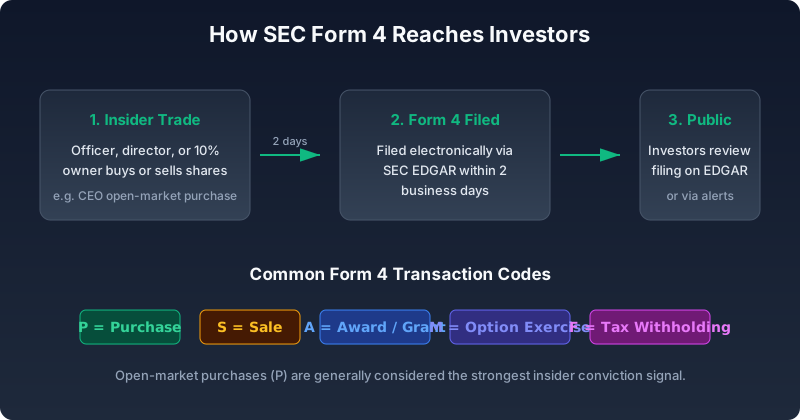
SEC Form 4 is the most important public document for tracking insider trading activity. Filed within two business days of any transaction by corporate officers, directors, and beneficial owners owning more than 10% of a company's stock, Form 4 reveals what insiders are doing with their own money — often before the rest of the market catches on.
Unlike quarterly earnings or press releases, Form 4 filings arrive in near real time — shortly after they are filed — through the SEC's EDGAR system. A CEO buying $1 million of stock on the open market sends a very different message than the same CEO receiving shares as part of a compensation package. Understanding the difference is what separates actionable signals from background noise. On DisclosureSignals, every Form 4 is scored using the methodology described on our signal methodology page.
Who Must File Form 4?
Section 16 of the Securities Exchange Act of 1934 requires "insiders" to report changes in their ownership of company securities. The three groups covered by Form 4 are:
- Officers of the company, such as the CEO, CFO, COO, President, and other executive vice presidents
- Directors serving on the board of directors
- Beneficial owners who directly or indirectly own more than 10% of any class of the company's voting securities
These individuals are often referred to collectively as "Section 16 insiders." Because they have access to non-public information about the company's strategy, financial condition, and competitive position, regulators require them to disclose trades quickly so the investing public can see whether management is putting more of its own capital at risk or cashing out.
Form 4 Filing Deadlines and Late Filings
Before the Sarbanes-Oxley Act of 2002, insiders had until the tenth day of the month following a transaction to report it. That long lag made the data far less useful. Today, Form 4 must be filed with the SEC within two business days of the transaction date.
For example, if a CFO purchases shares on a Tuesday, the Form 4 is generally due by the end of Thursday. If the trade happens on a Friday, the filing deadline is the following Tuesday. The two-day rule applies to most equity transactions, including purchases, sales, option exercises, and certain transfers.
Key Filing Rules
- Filed electronically through the SEC EDGAR system
- Due within two business days of the transaction
- Late filings can result in SEC enforcement action and fines
- Amendments are filed as Form 4/A when corrections are needed
- Transactions exempt from two-day reporting may still appear on annual Form 5
The compressed deadline makes Form 4 one of the freshest sources of management-sentiment data available to retail investors. DisclosureSignals monitors EDGAR every 15 minutes so users see high-signal trades shortly after they are filed.
Why the Filing Date Differs from the Transaction Date
Two dates appear on every Form 4, and confusing them is one of the most common research mistakes. The transaction date is when the insider actually bought, sold, exercised, or received shares. The filing date (the date EDGAR stamps the submission) generally falls two business days later. Between those dates sits the reporting pipeline: the insider notifies their broker or the company's general counsel, the filing agent assembles the document, and the submission is transmitted to EDGAR. When you screen for insider activity by filing date, you are therefore looking at trades that happened roughly two business days earlier — and, for late filers, much earlier still.
This lag matters when comparing Form 4 activity to price movements. A purchase reported on a Monday may have executed the previous Thursday. Sorting filings by transaction date rather than filing date keeps event studies and screens consistent, and it prevents attributing a week of market movement to a disclosure that only just appeared.
Who Counts as a Late Filer?
An insider is generally considered late once the filing arrives after the second business day following the transaction. In practice this happens frequently: SEC studies and academic research have documented that a meaningful share of Form 4 filings miss the two-business-day window, and some arrive weeks or even months after the trade. Because EDGAR displays the transaction date on the filing's face, a late filing is easy to spot — the gap between the two dates is printed right on the document. Insiders are expected to explain the delay in the form's footnotes, and recurring Section 16(a) late-filing violations must be disclosed in the company's annual proxy statement.
What Happens When Filers Are Late
A late filing does not undo the transaction or invalidate the disclosure, but it does create real consequences for the insider:
- Footnoted explanations. Late filers typically add a footnote describing the reason for the delay, such as an administrative error or an oversight by a filing agent.
- Proxy statement disclosure. Under Item 405 of Regulation S-K, the company must disclose any Section 16(a) late filings in its annual proxy statement each year.
- Potential SEC enforcement. The SEC has brought civil actions over chronic or willful late filings, resulting in penalties against officers, directors, and 10% owners.
- Reputational cost. Proxy advisors and governance researchers track late filers, and repeated violations can influence how governance scores weigh management.
For investors reading the filings, the practical takeaway is to check the gap between the transaction date and the filing date on every Form 4 you review. A trade that was disclosed promptly carries different context than a purchase that surfaced weeks later. DisclosureSignals uses the filing's own dates to show both, so you can judge timing quality yourself. As always, this page describes filings and filing behavior — it is not investment advice, and no statement here predicts how any stock will move.
What Transactions Are Reported on Form 4?
Form 4 captures any change in an insider's beneficial ownership of the company's equity securities. Common reportable events include:
- Open-market purchases and sales made through a broker on a public exchange
- Stock grants, awards, and restricted stock vesting from compensation plans
- Option exercises where the insider acquires shares by exercising a stock option
- Tax withholding sales used to cover the tax liability from vested equity
- Gifts and transfers to family members, trusts, or charitable organizations
- Transactions under Rule 10b5-1 plans, which are pre-scheduled trading plans
Not every transaction carries the same meaning. A routine grant or tax-withholding sale is usually not a statement about the company's future. A large open-market purchase with personal cash, on the other hand, is often interpreted as a strong vote of confidence.
How to Read a Form 4 Table
A Form 4 filing is divided into several sections. The most important fields for investors are in the transaction and ownership tables. Here is what to look for:
- Reporting Owner
- The insider's name and title, such as CEO, CFO, Director, or 10% Owner.
- Transaction Date
- The date the trade actually occurred, which may differ from the filing date.
- Transaction Code
- A one-letter code describing the nature of the transaction. See the table below.
- Shares
- The number of shares bought, sold, granted, or transferred.
- Price Per Share
- The average price paid or received per share.
- Shares Owned After
- The insider's total direct and indirect holdings after the transaction closes.
- Ownership Form
- Whether the shares are held directly, indirectly through a trust, or by a family member.
Common Form 4 Transaction Codes
Every transaction line on a Form 4 carries a one-letter transaction code defined in the instructions to the form itself. The code tells you whether the insider chose to trade or whether shares simply arrived through compensation or an administrative event — the single most important distinction when reading a filing. Here is a reference table of the codes you will actually encounter, with the SEC's own definition and why each one matters:
| Code | SEC Definition | Plain English | Why Investors Care |
|---|---|---|---|
| P | Open market or private purchase of non-derivative or derivative security | Open-market purchase — the insider bought shares with personal funds | Fully discretionary. Generally the most noteworthy transaction type under the scoring model, because the insider chose to commit personal capital. |
| S | Open market or private sale of non-derivative or derivative security | Open-market sale — the insider sold shares through a broker | Discretionary, but context matters: diversification, taxes, estate planning, and liquidity needs all trigger sales. A sale alone carries less information than a purchase. |
| A | Grant, award or other acquisition pursuant to Rule 16b-3(d) | Grant or award — shares received as compensation | Automatic. Part of the pay package, not a market decision. Not meaningful as a sentiment indicator. |
| M | Exercise or conversion of derivative security exempted pursuant to Rule 16b-3 | Option exercise — the insider converted stock options into shares | Compensation-driven and largely automatic, though the insider picks the timing. Watch what happens to the shares afterward: an exercise followed by a sale (M then S) is a different pattern than an exercise with shares held. |
| F | Payment of exercise price or tax liability by delivering or withholding securities incident to the receipt, exercise or vesting of a security issued in accordance with Rule 16b-3 | Tax withholding — shares withheld to cover taxes on vesting equity | Automatic payroll mechanic. Widely misread as a bearish insider sale; it is routine and usually not meaningful. |
| G | Bona fide gift | Gift — shares given to family members, trusts, or charities | Not a market transaction. No sale proceeds change hands. Usually estate or charitable planning; check footnotes for the recipient. |
| C | Conversion of derivative security | Conversion — one security form converted into another (e.g., preferred shares or warrants into common stock) | Mechanical. No cash changed hands at market prices, so it says little about the insider's market view on its own. |
| X | Exercise of in-the-money or at-the-money derivative security | Option exercise for options acquired outside Rule 16b-3 exemption | Like M, compensation-driven. Read it together with the footnotes and any follow-on sale. |
| D | Disposition to the issuer of issuer equity securities pursuant to Rule 16b-3(e) | Disposition — shares returned or sold back to the company itself | Administrative, not an open-market sale. Often tied to company programs rather than a personal trading decision. |
| I | Discretionary transaction in accordance with Rule 16b-3(f) resulting in acquisition or disposition of issuer securities | A discretionary transaction executed under a Rule 16b-3 exemption | Discretionary but uncommon. Read the footnotes to understand what actually happened. |
| J | Other acquisition or disposition (describe transaction) | Catch-all — any transaction that does not fit another code | The footnotes carry the real explanation here. Do not classify a J-coded filing as a buy or sell without reading them. |
| K | Transaction in equity swap or instrument with similar characteristics | Equity swap or similar hedging instrument, paired with another code (e.g., S/K) | Hedging context. The pairing matters — a S/K line is a sale executed inside a swap, not a simple market sale. |
A handful of other codes appear only rarely on EDGAR: V (a transaction voluntarily reported earlier than required — an indicator rather than a transaction type), E (expiration of a short derivative position), H (expiration or cancellation of a long derivative position with value received), O (exercise of an out-of-the-money derivative security), L (small acquisition under Rule 16a-6), W (acquisition or disposition by will or the laws of descent and distribution), Z (deposit into or withdrawal from a voting trust), and U (disposition pursuant to a tender of shares in a change-of-control transaction). The SEC's own transaction code reference lists every code with its full definition.
The thread running through the table is discretionary versus automatic. Codes P and S are genuine choices — the insider decided to commit or free personal capital, on a date and at a price they picked. Codes A, F, M, and C are compensation and administrative mechanics: the shares arrive, or leave, because of a plan that was set in motion months earlier. Scoring that treats every code identically drowns real decisions in a sea of payroll events, which is why raw code counts mislead (see common misreads below).
When reading a Form 4, always compare the transaction to the insider's total holdings. A CEO buying $50,000 of stock may be interesting, but a CEO increasing an already large position by 50% is far more telling. You can explore live examples for any ticker on DisclosureSignals, including popular pages like AAPL insider trades, TSLA insider trades, and NVDA insider trades.
Derivative Transactions and Footnotes (Table II)
Every Form 4 contains two transaction tables. Table I covers non-derivative securities — the common stock you think of when you picture a share. Table II covers derivative securities: stock options, restricted stock units (RSUs), warrants, convertible notes, and other instruments whose value derives from the company's stock. When an executive exercises options, receives an RSU vesting event, or converts a note, the transaction lands in Table II — and the underlying shares often show up in Table I in the same filing.
A typical executive filing looks like a two-step sequence. First, an M or X code in Table II records the option exercise: the insider converts options (usually granted years earlier at a fixed strike price) into shares. Then, in Table I, the same filing may show an S line where some of those newly acquired shares are sold — often to cover the exercise cost or taxes. Read as a pair, this is a compensation event. Read line-by-line as "insider bought then sold," it is nonsense. This is exactly why the tables and their codes must be interpreted together.
The footnotes are where the real context lives. The most important footnote flag is the Rule 10b5-1 check box and its accompanying explanation: it indicates the trade was made under a pre-adopted written trading plan that sets amounts, prices, and dates in advance. A 10b5-1 footnote changes how a transaction should be weighted:
- Scheduled, not spontaneous. A 10b5-1 sale was set in motion possibly months before it executed, at a time when the insider could not have known what the market would look like that day.
- Less informational weight for sales. Because the plan removes day-to-day discretion, a plan-based sale is treated as routine by most scoring approaches, including ours.
- Still noteworthy for purchases. Purchases are rarely run through 10b5-1 plans; a discretionary open-market purchase with no plan footnote remains the transaction type our model treats as most noteworthy.
- Plan details belong in footnotes. Rule 10b5-1(c) filings must state the plan's adoption date in the explanation of responses, and material-plan trades carry additional disclosure rules — useful context when judging how mechanical the trade was.
Other common footnotes explain gifts (naming the recipient), 401(k) or employee-stock-purchase plan activity, dividends reinvested, or transactions by a spouse or trust whose shares the insider beneficially owns. The rule of thumb: automatic-plan and compensation-driven transactions score differently from discretionary ones, and the footnote is what tells you which one you are looking at. DisclosureSignals reads these flags when scoring every filing — the mechanics are described on our signal methodology page.
Common Form 4 Misreads
Most errors people make when reading Form 4 filings trace back to treating every transaction line as a deliberate market decision. These are the misreads we see most often:
1. Option exercises are not buys
An M or X code records an option exercise — compensation converted into shares. The "purchase" price is the strike price agreed years ago, not today's market, and no cash was spent at market prices. Screens that count option exercises as insider buying routinely report "record buying" that is actually scheduled compensation vesting. What matters is what the filing shows next: shares held (the insider now owns more stock) versus shares immediately sold.
2. Tax-withholding sales are not bearish signals
An F code means shares were withheld to cover the tax bill on vesting equity. The insider does not choose the price, the date, or the share count in any meaningful sense — the withholding schedule and the tax rules do. F-coded "sales" are among the most common lines on EDGAR and are essentially noise. Treating them as insider selling will make almost every large-cap stock look like management is fleeing.
3. Gifts and transfers move shares, not opinions
G-coded gifts and estate transfers can involve enormous share counts — a founder moving stock into a family trust can dwarf every open-market trade that month. Nothing was bought or sold on a market. The insider's economic exposure usually does not change much (shares held indirectly through a trust are still beneficially owned), but raw "shares sold" counters will happily log the transfer as a massive exit.
4. Raw code counts mislead without scoring context
Count filings by code and you will find F and A lines outnumber P lines many times over — because payroll happens weekly and open-market purchases made with personal capital are, by their nature, occasional. That ratio tells you about compensation structures, not about management sentiment. A useful insider-data workflow separates what happened (the code) from what it says (discretion, size relative to holdings, cluster behavior, plan status). That separation is the entire point of the scoring model on our methodology page.
5. Two business days is the rule, not the reality you see
Late filings (covered above) mean the freshest filings on EDGAR are not always the freshest trades. Screens that treat filing date as transaction date systematically attribute market moves to disclosures that arrived after the fact.
Rather than hand-filtering codes, footnotes, and late filings on every filing, you can see pre-scored, de-noised filings on the insider trading screener and today's top-scoring transactions on the signals page. Both apply the transaction-code weighting described on our methodology page, so routine compensation mechanics do not appear as buy or sell activity.
Why Form 4 Matters for Investors
Open-market purchases made with an insider's own cash are generally treated as the most noteworthy Form 4 transaction type, because the insider is voluntarily increasing personal exposure to the company. This is a description of transaction characteristics, not a prediction of how any stock will perform.
- Open-market purchases (not stock grants) score highest under the model
- Cluster buying — multiple insiders reporting purchases within 30 days — meets additional scoring criteria
- Large relative positions (increasing holdings by 20%+) tie more personal capital to the position
- Contrarian buys during stock declines are a closely studied pattern, with mixed evidence on outcomes
Form 4 data is valuable because it is standardized, comparable, and public. Insiders are not allowed to trade on material non-public information, and when they buy with their own capital they are willing to tie their own money to the company's future. That is a noteworthy fact about the filing — it is not a forecast of returns, and purchases by insiders sometimes precede no gain at all.
Real Examples of High-Signal Form 4 Trades
The most instructive Form 4 filings share a few traits: open-market purchases, large dollar values relative to the insider's existing stake, and timing that runs against the prevailing narrative. Below are three archetypes that frequently appear in academic studies and in DisclosureSignals alerts.
1. The Contrarian CEO Buy
After a disappointing earnings report or sector-wide sell-off, a CEO purchases shares on the open market. The market is pricing in bad news, but the CEO is saying the decline is overdone. These filings are scored highly because the purchase is discretionary, large relative to the executive's salary, and timed against pessimism. This archetype is widely studied, and the DisclosureSignals score reflects the transaction's discretionary, large, contrarian characteristics — it is not a prediction of returns, and studies of post-announcement insider purchases show mixed, period-dependent results.
2. Cluster Buying Among the C-Suite
Cluster buying occurs when two or more insiders purchase shares within a short window. A classic example is when a CEO, CFO, and a board director all buy within the same month. One insider buying could be a personal financial decision; three independent insiders buying simultaneously is much harder to dismiss. On DisclosureSignals, cluster-buying patterns earn a higher signal score in our methodology.
3. The 10% Owner Adding to a Concentrated Bet
Activist investors and large beneficial owners already have significant capital committed. When a 10% owner increases that position by another 5% or more, it is a strong statement that they believe the stock is undervalued. These trades can also be precursors to proxy campaigns, strategic reviews, or M&A activity.
DisclosureSignals surfaces these patterns automatically. Our system scans every new Form 4, scores it from 0 to 100, and sends alerts for the highest-scoring filings so you do not have to read hundreds of raw SEC documents yourself.
Limitations and Disclaimers
Form 4 data is a powerful input, but it is not a crystal ball. Investors should treat it as one signal among many, not a guaranteed buy recommendation. Important limitations include:
- Not all purchases are bullish. Some are part of pre-planned 10b5-1 arrangements or required by employment contracts.
- Sales are not always bearish. Insiders sell for diversification, taxes, estate planning, and personal liquidity needs.
- Historical patterns do not guarantee future returns. Markets change, and past outperformance of insider-buying strategies may not repeat.
- Form 4 does not reveal motive. It shows what happened, not why it happened. Always read the footnotes.
- Delay and data errors happen. Filings can be amended, and EDGAR data can contain formatting issues.
Nothing on this page constitutes investment advice. DisclosureSignals is an information and research tool. Always do your own due diligence or consult a licensed financial advisor before making investment decisions.
Frequently Asked Questions
What is SEC Form 4?
SEC Form 4 is a disclosure filing required whenever a company insider buys or sells shares. It must be filed within two business days and reveals the insider's name, role, transaction date, number of shares, price, and holdings after the trade.
Who has to file Form 4?
Corporate officers, directors, and beneficial owners who hold more than 10% of a company's voting securities must file Form 4.
How soon must Form 4 be filed after a trade?
Form 4 must be filed within two business days of the transaction, a requirement established by the Sarbanes-Oxley Act of 2002.
What is the difference between Form 3, Form 4, and Form 5?
Form 3 is the initial ownership statement when someone becomes an insider. Form 4 reports changes in ownership. Form 5 is an annual catch-up filing for exempt transactions not reported on Form 4.
What do Form 4 transaction codes mean?
P means open-market purchase, S means open-market sale, A means grant or award, M means option exercise, F means tax withholding, and G means gift. Purchases are generally considered the strongest signal.
Is every Form 4 filing a useful trading signal?
No. Many filings are routine. DisclosureSignals scores every filing and filters out low-signal noise so investors can focus on discretionary, high-signal transactions.
When is a Form 4 filed?
A Form 4 is generally filed within two business days of the insider's transaction date. If the second business day falls on a weekend or SEC holiday, the deadline moves to the next business day. In practice some filers miss the deadline, and late filings can surface weeks after the transaction — sometimes with a Form 4/A amendment or an explanatory footnote about the delay.
What are Form 4 transaction codes?
Transaction codes identify the nature of each reported transaction: P (open-market purchase), S (open-market sale), A (grant or award), M (option exercise under Rule 16b-3), F (tax withholding on vesting shares), G (bona fide gift), and X (exercise of an in-the-money or at-the-money derivative), among others including C, D, I, J, K, L, O, U, W, and Z. Codes P and S are discretionary decisions; codes like A, F, and M are compensation-driven mechanics. The full table is in the transaction codes section above.
What happens if an insider files Form 4 late?
A late filing does not invalidate the transaction. Late filers are expected to explain the delay in the filing's footnotes, the company must disclose Section 16(a) late filings in its annual proxy statement, and the SEC can pursue enforcement for chronic or willful failures to file on time. Late filings still appear on EDGAR and remain searchable.
Is a Form 4 purchase bullish?
A Form 4 purchase is a disclosed fact, not a prediction of returns. An open-market purchase shows that an insider voluntarily committed personal capital at the reported price, which is why it is treated as a noteworthy transaction characteristic. Whether the stock rises afterward depends on many factors outside the filing, and studies of post-purchase returns show mixed results. Treat Form 4 data as one research input — this page is not investment advice.
Start Tracking Insider Trades Today
DisclosureSignals monitors SEC EDGAR every 15 minutes and scores every Form 4 filing automatically. Explore signals for free, or upgrade to a paid plan for near-real-time filing alerts, advanced filters, and unlimited watchlists. See live signals for AAPL, TSLA, NVDA, or any ticker you follow.
View Free Dashboard →Related Guides
Elected Officials
What Are Congressional Stock Trades?
How elected officials disclose stock trades and why traders track them.
Institutional Filings
What Is a 13F Filing?
Quarterly holdings reports from hedge funds and institutional investors.
Learn how we score every filing on our Signal Methodology page, or upgrade to a paid plan for near-real-time filing alerts.